
He wasn’t ready to sell.
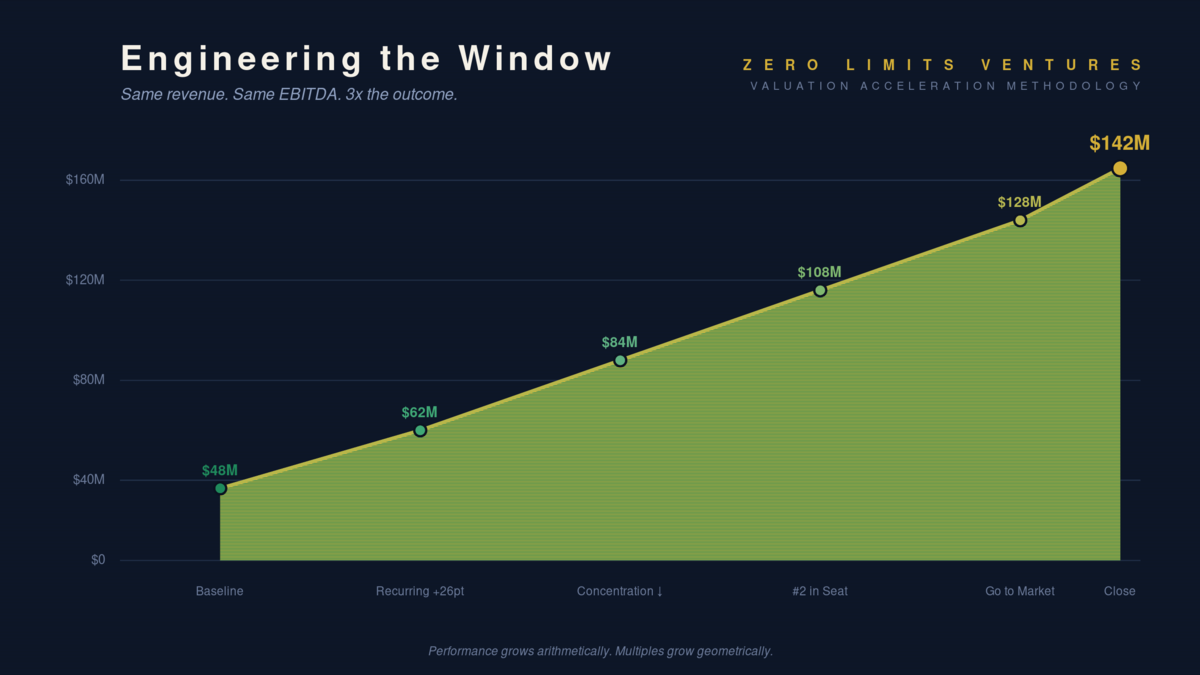
Eight years in. $32M in revenue, 18% EBITDA margins, growing 22% a year. The kind of business that draws unsolicited inbounds from sponsors every other month. He had entertained a few. The numbers came back in the high $40s — call it $48M on a good day.
Decent. Not life-changing.
His wife asked the right question over dinner one night: “What would have to be true for it to be life-changing?”
He didn’t have an answer.
That conversation is when he called us.
We did a VAM assessment — the 26-driver analysis we run before any engagement — and the gap it surfaced wasn’t a problem with the company. It was a problem with the story the company was telling.
On paper, it looked like a $48M business. In reality, it was a $48M business operating like a $48M business. Three drivers in particular were leaving real money on the table.
Recurring revenue was 41%. The other 59% was project work — high-margin but lumpy. Buyers discount lumpy.
Customer concentration had his top three accounts at 38% of revenue. Defensible internally, expensive externally. Every sophisticated buyer’s first diligence question is what happens if your top customer leaves?
Senior management depth stopped at the founder. He was still in every customer relationship that mattered. That is a founder discount, and it routinely costs sellers 1.5x to 2x off their multiple.
We did not take the sell-side engagement that day. We told him what we tell anyone in his position: the window is not open yet — and you are the one who decides when it is.
He went back to work. For the next sixteen months, with our team in the seat alongside his, he ran a different playbook. Not a transformation. Not a pivot. A series of disciplined, sequenced shifts:
- A retainer-and-managed-services overlay on the project business — moved recurring revenue from 41% to 67%.
- A deliberate reweighting of the customer base — top-three concentration down from 38% to 22%, with twelve new logos that mattered.
- A real #2 hired and properly empowered. Six months of discipline spent keeping the founder out of the conversations he used to drive.
When we took him to market in month seventeen, the company’s revenue had grown 19% — completely in line with its prior trajectory. EBITDA margins were a hair better, not dramatically.
The financials, in other words, looked unremarkable.
The story, however, was unrecognizable.
He closed at $142 million.
Roughly 3x the indication he had held in his hand eighteen months earlier — on a business that, by the income statement alone, was only modestly larger.
That is the part most founders miss.
Performance grows arithmetically. Multiples grow geometrically.
The same dollar of EBITDA is worth wildly different amounts depending on the structural story underneath it. Two companies with identical financials will routinely transact at multiples that differ by 3x — sometimes 5x — because of the structural drivers buyers actually price.
We call this engineering the window — the active, deliberate counterpart to riding the opportunity. Where riding is passive, engineering is intentional. Where riding lets the market dictate your multiple, engineering reshapes the company so the multiple has somewhere to climb.
This is precisely what our Valuation Acceleration Methodology was built to do. The 26 drivers behind VAM are not a checklist — they are the levers that determine, with surprising precision, what your forward conviction story will be when it hits a sophisticated buyer’s desk. Pull the right ones, in the right order, with the right runway, and 2x to 6x multiple expansion is not aspirational. It is mechanical.
The two questions every founder eventually faces are should I sell? and for how much? Most spend their energy on the first question and almost none on the second.
The first question has an obvious answer for most founders, eventually.
The second one is the one we built our firm to answer.
Thirty minutes is usually enough to know which levers are sitting unused in your business — and what they are worth.
Grab time on my calendar. No pitch, no obligation — a candid look at your structural multiple and how much of it is currently being earned vs. left on the table.
Steve Little
Founder & Managing Partner
Zero Limits Ventures
Zero Limits Ventures is a sell-side investment bank serving middle-market founders generating $15M–$250M in annual revenue. We act as banker of record and execute the full M&A process end-to-end. To unsubscribe, reply with “remove.”