
She built it from nothing.
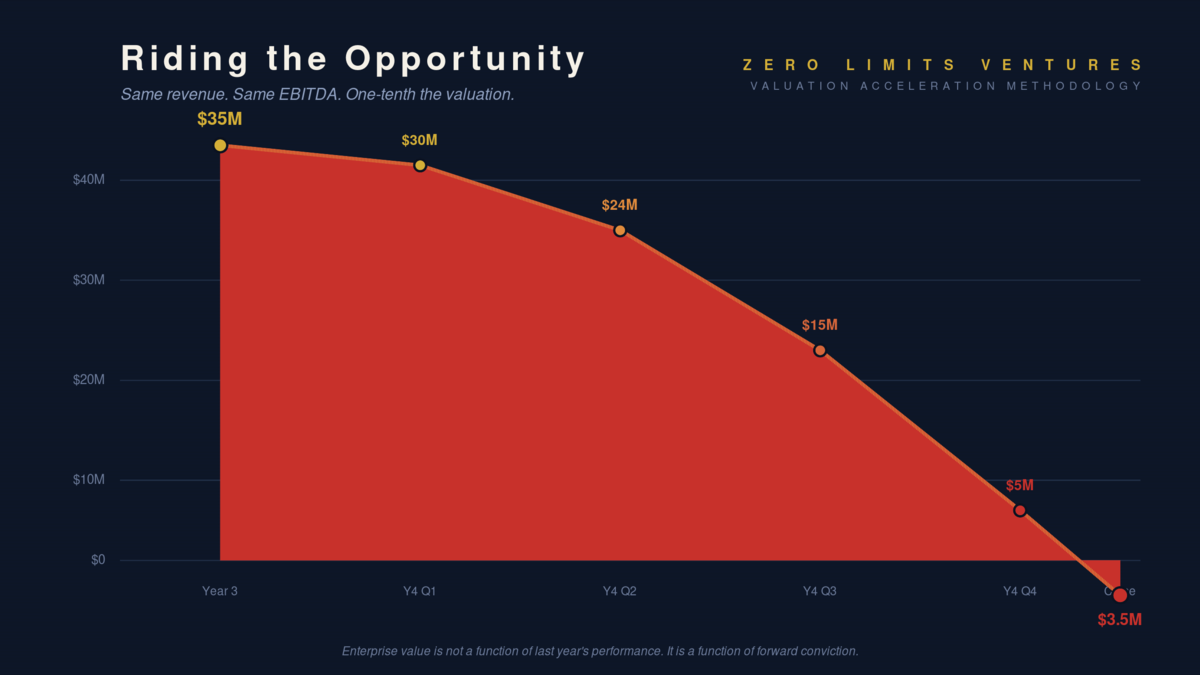
Three years in, her company was producing healthy eight-figure revenue, EBITDA was strong, and the growth curve looked like the kind of thing investors put on slide one of a pitch deck. When she finally commissioned a formal enterprise valuation, the number came back at $35 million.
That is a life-changing number. Pay off the house. Set up the kids. Take the trip. Still have plenty left to fund the next thing. F-you money, as she put it — and she had earned every dollar of it.
She didn’t sell.
The reasoning was reasonable enough. Why exit at the inflection point? Year four was already booked. Pipeline looked strong. Two senior hires had just started. Everything looked good.
Until, halfway through year four, it didn’t.
There was nothing dramatic about it. Nothing she could put a finger on. Revenue kept coming in. EBITDA even ticked up, modestly. But something in the business felt — flat. The energy that had defined the first three years had quietly drained out of the room. Customers were renewing, not raving. The team was executing, not building. The story she had been telling for four years was still true on paper, and somehow no longer true in the market’s eyes.
Then the valuation indications started moving.
$30 million….
$24 million….
$15 million….
$5 million….
Same revenue. Similar EBITDA. Entirely different multiple.
Buyers, capital, sentiment — the whole market — had collectively decided her company wasn’t what they thought it was anymore. The growth narrative had a shelf life, and she had run past it without realizing it. By the time the financials caught up to what the market already knew, there was no narrative left to sell.
The bottom fell out almost overnight.
She closed at $3.5 million. Still a respectable outcome by most measures. Not nothing. But not the $35 million she had held in her hand twelve months earlier, and certainly not the rest-of-her-life number she had pictured every single time she said not yet.
At Zero Limits Ventures, we call this riding the opportunity over the top — staying on the wave one beat too long, mistaking momentum for moat, confusing recent growth for current value. It happens all the time. In fact, it is the single most common pattern we see in founder-led companies in the $15M–$250M range, and it almost never announces itself before it’s too late.
The hard truth most founders learn in the rearview mirror: enterprise value is not a function of last year’s performance. It is a function of forward conviction. When the market’s conviction in your story shifts — quietly, often invisibly, even while the financials still look fine — the multiple shifts with it. By the time the income statement catches up, the deal you wanted is gone.
This is precisely why we built our Valuation Acceleration Methodology. The 26 drivers behind VAM exist to do two things at the same time: quantify what is actually creating enterprise value in your business today, and surface — well in advance — the structural shifts that signal your window is closing. We have used VAM to engineer 2x to 6x valuation gains for sellers who engaged early. We have used it just as often to tell a founder, candidly, that their window is now.
If you have ever asked yourself the question she asked — should I sell? — the right answer is rarely “wait and see.” The right answer is to measure, with discipline, what you are actually working with and what is actually moving underneath you.
Thirty minutes is usually enough to tell.
Grab time on my calendar. No pitch, no obligation — just a candid look at where your value sits today and where it is most likely heading.
Steve Little
Founder & Managing Partner
Zero Limits Ventures
steve@zerolimitsventures.com