
Every founder I've sat across the table from knows the price on the offer. Far fewer know how much of it they'll actually get at closing.
I like to use the term transaction value, or transferable value: what you could actually derive from the act of the sale of your business.
Valuation is what the business is worth on paper. Transaction value is what you actually take home, and when.
The gap lives in the deal structure, meaning how the price gets paid:
- Cash at closing: paid the day the sale closes.
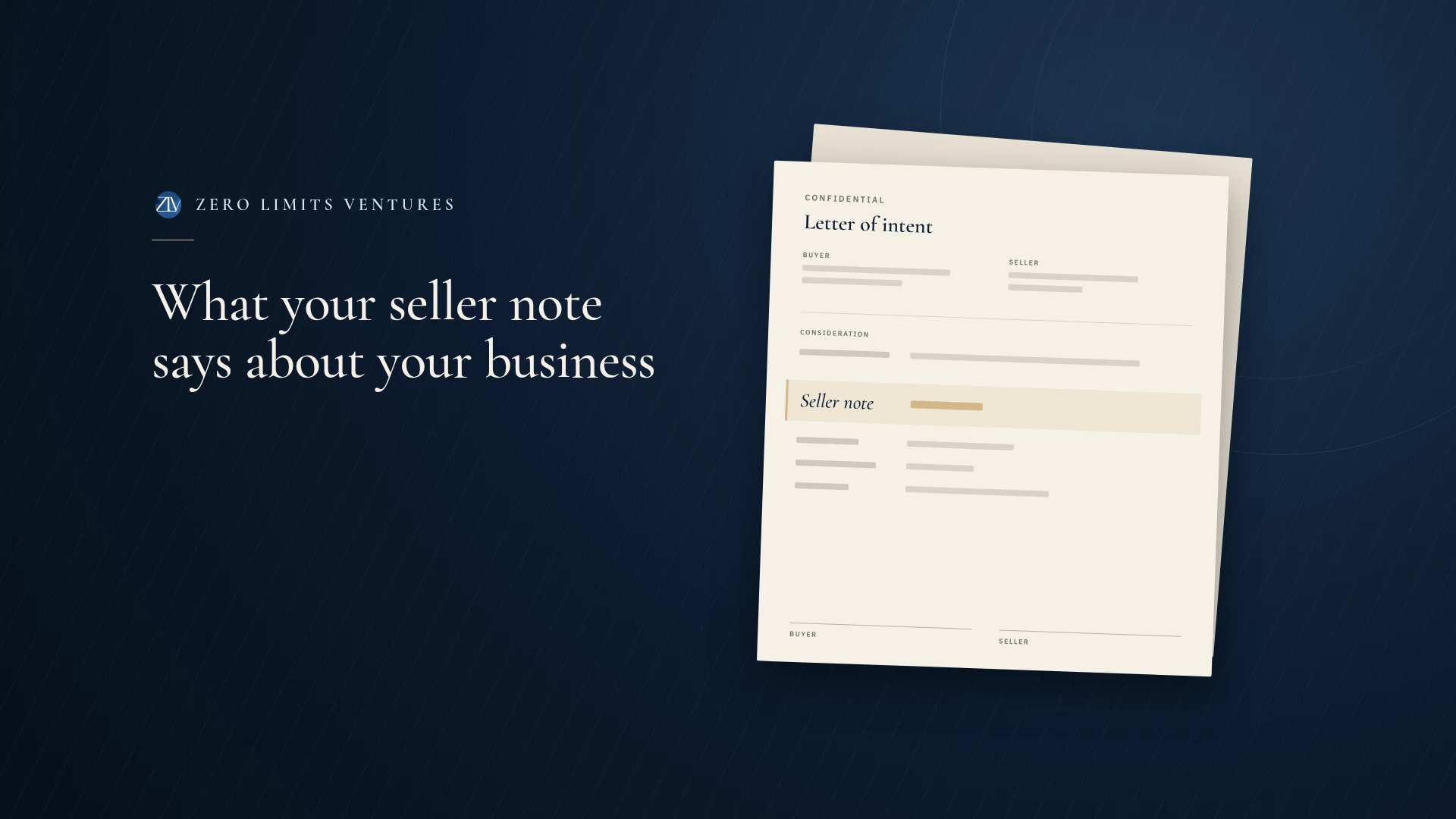
- A seller note: you lend the buyer part of the price, repaid over time with interest.
- An earnout: paid later, only if the business hits agreed targets.
- Rollover equity: you keep a stake after the sale.
What 40+ years at the table taught me
In 400+ deals, I've watched founders try to close that gap by pushing harder on price.
But if you negotiate hard on a price, the buyer will usually put some sort of earn-out term on that money, meaning something else has to happen in order for you to get the rest of your money.
Pushing on price doesn't remove the buyer's risk. It moves part of your money later and ties it to what happens after closing.
That isn't the buyer being difficult. It's a reasonable way to manage the risk they see.
A seller note works the same way: the buyer prices in the risk and hands part of it back to you.
The overriding principle in selling a company hasn't changed: high risk, low price. Low risk, high price.
How you get paid is set during the sale, too
The one rule you cannot break under any circumstances: if you projected a number, you got to hit the number. If you don't, the price drops off precipitously, because the buyer sees it as risk.
Real numbers on an old pattern
Kaitlinn Thatcher at Axial just put data behind what I've watched for decades, with 100 signed letters of intent (LOIs, a buyer's written offer) from Axial members. Her piece is worth any founder's time.
In Axial's sample, the median deal paid 75.0% of total enterprise value (TEV, the total price including debt) in cash at closing, with a median seller note of 15.4% of TEV.
And 1 in 4 carried a seller note of 25% or more of TEV.
She calls it a limited sample, not a comprehensive study. It matches what I've seen at the table.
Different buyers, different structures
Her breakdown by buyer type is the part I'd read twice. In Axial's sample, independent sponsors (dealmakers who raise money deal by deal) had a median note of 17.8% of TEV, and corporations 12.5%.
Each buyer is going to value your business differently, based on how much more valuable their business will be by owning yours. Behind the price on the offer, there might be earnouts and debt and other kinds of financing details.
That's why the right buyer matters as much as the price.
Where the work happens
How the price gets paid is shaped long before a buyer puts an offer in writing. At ZLV, that work has three parts:
1. Release constrained value. Find the risk holding value back across the 26 value drivers, and remove it.
2. Accelerate valuation. Pull the drivers that matter most to your likely buyers.
3. Find the right buyer. Evaluate the buyer the way we evaluate the business.
What's possible
In one of our published case studies, a regional trucking company repositioned as an energy logistics supplier, and its valuation rose significantly. The sale was a cash transaction with no earnout and no holding period, meaning the founders didn't have to stay on after the sale.
That's one company, not a promise. It shows what's possible when a buyer sees less risk to price in.
A short self-test
If a buyer looked at your business today, which risks would they price into a note or an earnout?
Could you hit every number you'd put in front of a buyer?
Does the business run without you, or would a buyer need you to stay?
The lower the risk of ownership, the higher the value of the company. Every deal structure I've seen comes back to that.
If those questions are hard to answer, my masterclass walks through how buyers read risk: zerolimitsventures.com/masterclass